# skipgram_numpy_from_scratch.py
# Author: you & ChatGPT — Minimal, readable, no deep deps.

import re
import math
import random
import numpy as np
from collections import Counter, defaultdict

# ----------------------------
# 1) Utils
# ----------------------------
def tokenize(text):
    """Tokenize rất đơn giản: chữ thường + tách theo \w+"""
    return re.findall(r"[a-zA-Z']+", text.lower())

def build_vocab(tokens, min_count=1):
    """Tạo vocab và lọc từ hiếm."""
    freq = Counter(tokens)
    vocab = [w for w, c in freq.items() if c >= min_count]
    vocab.sort()
    word2id = {w:i for i, w in enumerate(vocab)}
    id2word = {i:w for w,i in word2id.items()}
    counts = np.array([freq[w] for w in vocab], dtype=np.float64)
    return word2id, id2word, counts

def subsample_tokens(tokens, counts, word2id, t=1e-5):
    """Subsampling theo paper word2vec: keep prob ~ min(1, sqrt(t/f) + t/f).
       Cho corp nhỏ có thể tắt = None."""
    if t is None:
        return tokens
    total = sum(counts)
    freqs = {w: counts[word2id[w]] / total for w in word2id}
    kept = []
    for w in tokens:
        if w not in word2id:
            continue
        f = freqs[w]
        p_keep = min(1.0, (math.sqrt(t/f) + t/f))
        if random.random() < p_keep:
            kept.append(w)
    return kept

def make_skipgram_pairs(token_ids, window_size=2):
    """Sinh cặp (center, context) với cửa sổ cố định."""
    pairs = []
    for i, c in enumerate(token_ids):
        left = max(0, i - window_size)
        right = min(len(token_ids), i + window_size + 1)
        for j in range(left, right):
            if j == i:
                continue
            pairs.append((c, token_ids[j]))
    random.shuffle(pairs)
    return pairs

def make_unigram_table(counts, power=0.75):
    """Phân phối negative sampling ∝ count^power (không dùng alias table, đủ cho corp nhỏ)."""
    p = counts ** power
    p = p / p.sum()
    return p

def sigmoid(x):
    # clip để ổn định số học
    x = np.clip(x, -10, 10)
    return 1.0 / (1.0 + np.exp(-x))

def cosine_sim(a, b):
    a_norm = a / (np.linalg.norm(a) + 1e-9)
    b_norm = b / (np.linalg.norm(b) + 1e-9)
    return float(np.dot(a_norm, b_norm))

# ----------------------------
# 2) Skip-Gram NS Model
# ----------------------------
class SkipGramNS:
    def __init__(self, vocab_size, embed_dim=100, seed=42):
        rng = np.random.default_rng(seed)
        # Ma trận embedding input (V x D) và output (V x D)
        self.W_in = rng.normal(0, 0.01, size=(vocab_size, embed_dim)).astype(np.float64)
        self.W_out = rng.normal(0, 0.01, size=(vocab_size, embed_dim)).astype(np.float64)

    def train(
        self,
        pairs,
        neg_dist,
        neg_k=5,
        lr=0.025,
        epochs=2,
        anneal=True,
        report_every=10000
    ):
        """Huấn luyện SGD từng cặp với K negative."""
        V, D = self.W_in.shape
        step = 0
        for ep in range(1, epochs+1):
            random.shuffle(pairs)
            total_loss = 0.0

            for c_id, o_id in pairs:
                # 1) Sample negatives
                neg_ids = np.random.choice(V, size=neg_k, replace=True, p=neg_dist)
                # Tránh trùng positive context (không bắt buộc)
                neg_ids[neg_ids == o_id] = np.random.choice(V, p=neg_dist)

                v_c = self.W_in[c_id]               # (D,)
                u_o = self.W_out[o_id]              # (D,)
                u_neg = self.W_out[neg_ids]         # (K, D)

                # 2) Scores
                s_pos = np.dot(v_c, u_o)            # scalar
                s_neg = np.dot(u_neg, v_c)          # (K,)

                # 3) Sigmoid
                p_pos = sigmoid(s_pos)              # σ(v·u_o)
                p_neg = sigmoid(s_neg)              # σ(u_n·v)

                # 4) Loss: -log σ(pos) - Σ log σ(-neg)
                # log σ(-x) = log(1 - σ(x))
                loss = -np.log(p_pos + 1e-12) - np.sum(np.log(1.0 - p_neg + 1e-12))
                total_loss += loss

                # 5) Gradients
                # dL/dv = (σ(pos)-1)*u_o + Σ σ(neg)*u_n
                grad_v = (p_pos - 1.0) * u_o + np.sum(p_neg[:, None] * u_neg, axis=0)

                # dL/du_o = (σ(pos)-1)*v
                grad_uo = (p_pos - 1.0) * v_c

                # dL/du_n = σ(neg)*v  (cho từng negative)
                grad_un = (p_neg[:, None] * v_c[None, :])

                # 6) Update
                self.W_in[c_id]  -= lr * grad_v
                self.W_out[o_id] -= lr * grad_uo
                self.W_out[neg_ids] -= lr * grad_un

                # 7) LR anneal nhẹ theo bước (tùy chọn)
                step += 1
                if anneal and step % 100000 == 0:
                    lr = max(lr * 0.9, 0.0005)

                if report_every and step % report_every == 0:
                    avg = total_loss / report_every
                    print(f"[epoch {ep}] step={step} avg_loss={avg:.4f}")
                    total_loss = 0.0

    def most_similar(self, word, word2id, id2word, topk=10, use='in'):
        """Tìm từ gần nhất theo cosine trong không gian input (mặc định) hoặc output."""
        if word not in word2id:
            return []
        wid = word2id[word]
        vec = (self.W_in if use == 'in' else self.W_out)[wid]
        mat = self.W_in if use == 'in' else self.W_out

        sims = mat @ (vec / (np.linalg.norm(vec) + 1e-9))
        # loại chính nó
        sims[wid] = -1.0
        top_ids = np.argsort(-sims)[:topk]
        return [(id2word[i], float(sims[i])) for i in top_ids]


# ----------------------------
# 3) Demo ngắn
# ----------------------------
if __name__ == "__main__":
    random.seed(0)
    np.random.seed(0)

    # Một corpus toy; bạn thay bằng văn bản lớn hơn để học tốt hơn
    raw_text = """
    We are what we repeatedly do. Excellence, then, is not an act, but a habit.
    The only limit to our realization of tomorrow is our doubts of today.
    Not all those who wander are lost. To be, or not to be.
    """

    tokens = tokenize(raw_text)
    word2id, id2word, counts = build_vocab(tokens, min_count=1)

    # (Optional) subsample — với corpus nhỏ, nên tắt để khỏi mất dữ liệu
    tokens_kept = subsample_tokens(tokens, counts, word2id, t=None)

    token_ids = [word2id[w] for w in tokens_kept if w in word2id]
    pairs = make_skipgram_pairs(token_ids, window_size=2)

    neg_dist = make_unigram_table(counts, power=0.75)

    model = SkipGramNS(vocab_size=len(word2id), embed_dim=50, seed=42)
    model.train(
        pairs,
        neg_dist=neg_dist,
        neg_k=5,
        lr=0.05,
        epochs=5,
        anneal=True,
        report_every=2000
    )

    # Thử xem từ gần nhất
    query_words = ["not", "be", "habit", "limit", "today"]
    for qw in query_words:
        sims = model.most_similar(qw, word2id, id2word, topk=5)
        print(f"\nNearest to '{qw}':")
        for w, s in sims:
            print(f"  {w:>10s}  cos={s:.3f}")
Subsampling
Loại bỏ các tokens có tần suất xuất hiện nhiều nhưng không có quá nhiều ý nghĩa. (Loại bỏ stopword)
def subsample_tokens(tokens, counts, word2id, t=1e-5):
    """Subsampling theo paper word2vec: keep prob ~ min(1, sqrt(t/f) + t/f).
       Cho corp nhỏ có thể tắt = None."""
    if t is None:
        return tokens
    total = sum(counts)
    freqs = {w: counts[word2id[w]] / total for w in word2id}
    kept = []
    for w in tokens:
        if w not in word2id:
            continue
        f = freqs[w]
        p_keep = min(1.0, (math.sqrt(t/f) + t/f))
        if random.random() < p_keep:
            kept.append(w)
    return kept
Ở đây hàm sẽ tính tần suất xuất hiện của từ và so với xác suất giữ lại bằng công thức sau: Trong đó:
- là tần suất của từ
- là tham số ngưỡng được cung cấp (có thể hiểu như một ngưỡng thấp cho tần suất).
- Nếu lớn hơn 1 thì ta lấy 1.
Sau đó Hàm
random.random()sinh ra một số ngẫu nhiên từ 0 đến 1. Nếu giá trị này nhỏ hơn sẽ được giữ lại.
Lựa chọn cặp center
def make_skipgram_pairs(token_ids, window_size=2):
    """Sinh cặp (center, context) với cửa sổ cố định."""
    pairs = []
    for i, c in enumerate(token_ids):
        left = max(0, i - window_size)
        right = min(len(token_ids), i + window_size + 1)
        for j in range(left, right):
            if j == i:
                continue
            pairs.append((c, token_ids[j]))
    random.shuffle(pairs)
    return pairs
Ví dụ:
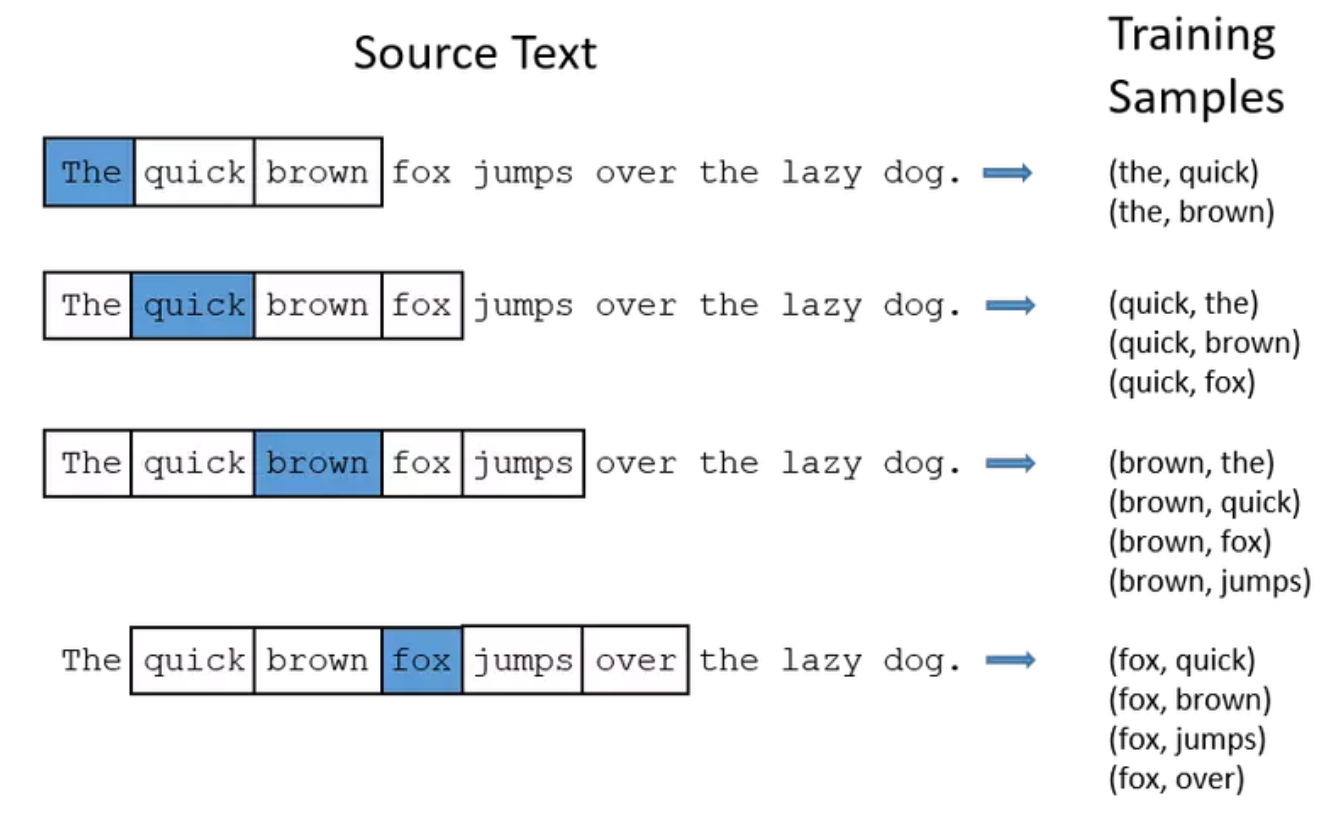
Tham số cho class NSkip
def __init__(self, vocab_size, embed_dim=100, seed=42):
        rng = np.random.default_rng(seed)
        # Ma trận embedding input (V x D) và output (V x D)
        self.W_in = rng.normal(0, 0.01, size=(vocab_size, embed_dim)).astype(np.float64)
self.W_out = rng.normal(0, 0.01, size=(vocab_size, embed_dim)).astype(np.float64)- Vocab_size: Số lượng từ vựng
- Embed_dim: số lượng chiều Embedding.
Khởi tạo ngẫu nhiên ma trận có kích thước Vocab_size x Embed_dim:
undefinedW_{\text{in}}= \begin{bmatrix} 0.10 & 0.00\ \color{#0b5}{0.00} & \color{#0b5}{0.20}\ -0.10 & 0.10\ 0.05 & -0.05 \end{bmatrix},\qquad W_{\text{out}}= \begin{bmatrix} \color{#0b5}{0.00} & \color{#0b5}{0.10}\ 0.10 & -0.10\ -0.10 & -0.10\ 0.00 & -0.20 \end{bmatrix}
\mathbf v_c = W_{\text{in}}[1] = \begin{bmatrix}0\0.20\end{bmatrix},\quad \mathbf u_o = W_{\text{out}}[0] = \begin{bmatrix}0\0.10\end{bmatrix},\quad \mathbf u_{n_1} = W_{\text{out}}[2] = \begin{bmatrix}-0.10\-0.10\end{bmatrix},\quad \mathbf u_{n_2} = W_{\text{out}}[3] = \begin{bmatrix}0\-0.20\end{bmatrix}.
undefined\begin{aligned} \sigma(s_{\text{pos}}) &\approx \sigma(0.02) \approx \boxed{0.5050},\ \sigma(s_{n_1}) &\approx \sigma(-0.02) \approx \boxed{0.4950},\ \sigma(s_{n_2}) &\approx \sigma(-0.04) \approx \boxed{0.4900}. \end{aligned}
\mathcal{L} = - \log \sigma(\mathbf{v}_c^\top \mathbf{u}o) - \sum{k=1}^{K} \log \sigma(- \mathbf{v}c^\top \mathbf{u}{n_k})
\mathcal L = -\log \sigma(s_{\text{pos}})
- \sum_{k=1}^{2} \log!\bigl(1-\sigma(s_{n_k})\bigr) \approx -\log(0.5050) - \log(0.5050) - \log(0.5100) \approx \boxed{2.039}.